

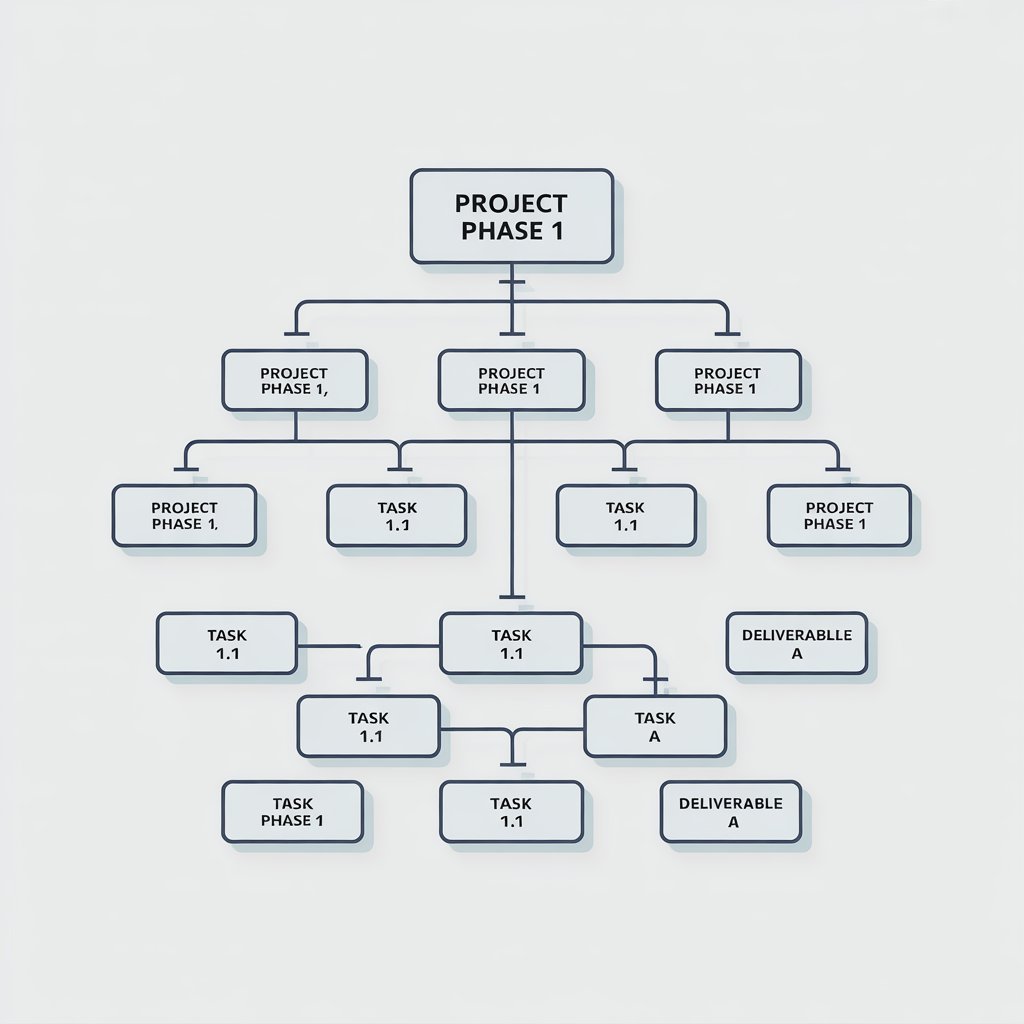
If you’re new to project management, you’ve probably had this feeling: you’re staring at a new project, and it feels like a giant, undefined, overwhelming blob.
You have a final goal (“launch the new app”), but the path from “here” to “there” is a fog. Where do you even begin? How do you make sure you don’t miss a critical part?
You begin with a Work Breakdown Structure (WBS).
This simple-sounding tool is the single most important document you can create to prevent failure. It’s the “magic trick” that turns a chaotic, intimidating project into a clear, actionable plan.
Kas yra darbo struktūros skaidymas (WBS)?
A Work Breakdown Structure is a hierarchical decomposition of the total scope of work to be carried out by a project team.
In simple English: It’s a map that breaks your giant project into small, manageable pieces.
It starts with your final goal at the top and breaks it down into smaller and smaller deliverables (the “what” you are building) until you have individual pieces that can be managed. These small pieces are called “work packages.”
The Most Important Rule: Nouns, Not Verbs!
This is the #1 mistake beginners make. A WBS is not a to-do list. It is not a schedule. It does not list activities (verbs).
It lists deliverables and Rezultatai (nouns).
- Wrong (Verbs): “Design the homepage,” “Code the login,” “Test the button.”
- Right (Nouns): “Homepage Design,” “Login Module,” “Test Results.”
Why the difference? Because you are defining the scope (what you’re building), not the schedule (how you’re building it). You can’t schedule the “how” until you’ve agreed on the “what.”
Why You Absolutely Need One
Creating a WBS might feel like extra paperwork, but it will save you from the three biggest project-killers.
1. It is Your #1 Weapon Against Scope Creep
This is the most important reason. “Scope creep” is when your project slowly grows bigger and bigger with “small, “easy” new requests.
Your WBS is your shield. You get your client and team to agree: “If it is not in the WBS, it is not in the project.”
When a stakeholder asks for a “small new feature,” you can pull out the WBS and say, “Great idea! That’s not in our current scope. I can create a formal change request to assess the impact on our budget and timeline.” It turns a “yes/no” argument into a professional process.
2. It Makes Accurate Estimating Possible
You cannot accurately estimate the time or cost of a “blob.”
- Impossible to Estimate: “How long will the ‘New App’ take?”
- Possible to Estimate: “How long will the ‘User Login Mockup’ take?”
By breaking the project into small “work packages,” you can ask your team to provide realistic estimates for each small piece. Add them up, and you have your total project estimate.
3. It Creates Total Team Clarity
The WBS is a visual map of the entire project. Everyone on the team can see the full picture, understand how their piece fits into the puzzle, and see what’s not their responsibility. This prevents both duplicate work and tasks from falling through the cracks.
4. It’s the Foundation for Your Schedule
You cannot create a project schedule, Gantt chart, or budget until you have a WBS. The WBS defines what you’re doing; the schedule defines when you’re doing it. The WBS always comes first.
How to Create a Simple WBS (A Quick Example)
You don’t need fancy software. You can do this on a whiteboard or with sticky notes.
Let’s use the example of a “New E-commerce Website.”
Level 1: The Final Project 1.0 New E-commerce Website
Level 2: The Major Deliverables (Phases) (Break down the project into its main components.)
1.1 Project Management1.2 Website Design1.3 Website Development1.4 Content1.5 Testing
Level 3: Work Packages (Break down each Level 2 component into smaller, manageable nouns.)
1.2 Website Design1.2.1 Homepage Mockup1.2.2 Product Page Template1.2.3 Checkout Process Wireframe
1.3 Website Development1.3.1 Homepage (HTML/CSS)1.3.2 Shopping Cart Module1.3.3 Payment Gateway Integration
1.4 Content1.4.1 Product Descriptions1.4.2 "About Us" Page Copy
…and so on. You stop breaking it down when you have a “work package”—a piece of work that is small enough to be easily understood, estimated, and assigned to a single person or team.
Don’t Skip This Step
The Work Breakdown Structure is not just “extra work.” It’s the foundational work. It’s the act of turning a vague idea into a concrete, shared, and measurable plan.
Taking an hour to build a WBS at the start will save you weeks of confusion, conflict, and scope creep down the line. It’s the first and most important step in moving from a beginner to a “guru” PM.
Feeling overwhelmed by your project’s scope?
Breaking down a complex IT project can be the hardest part. If you need an expert to help you define your scope and build a clear, actionable plan, let’s talk.
[Contact me] for a consultation.
 LT
LT  EN
EN  RU
RU  HE
HE