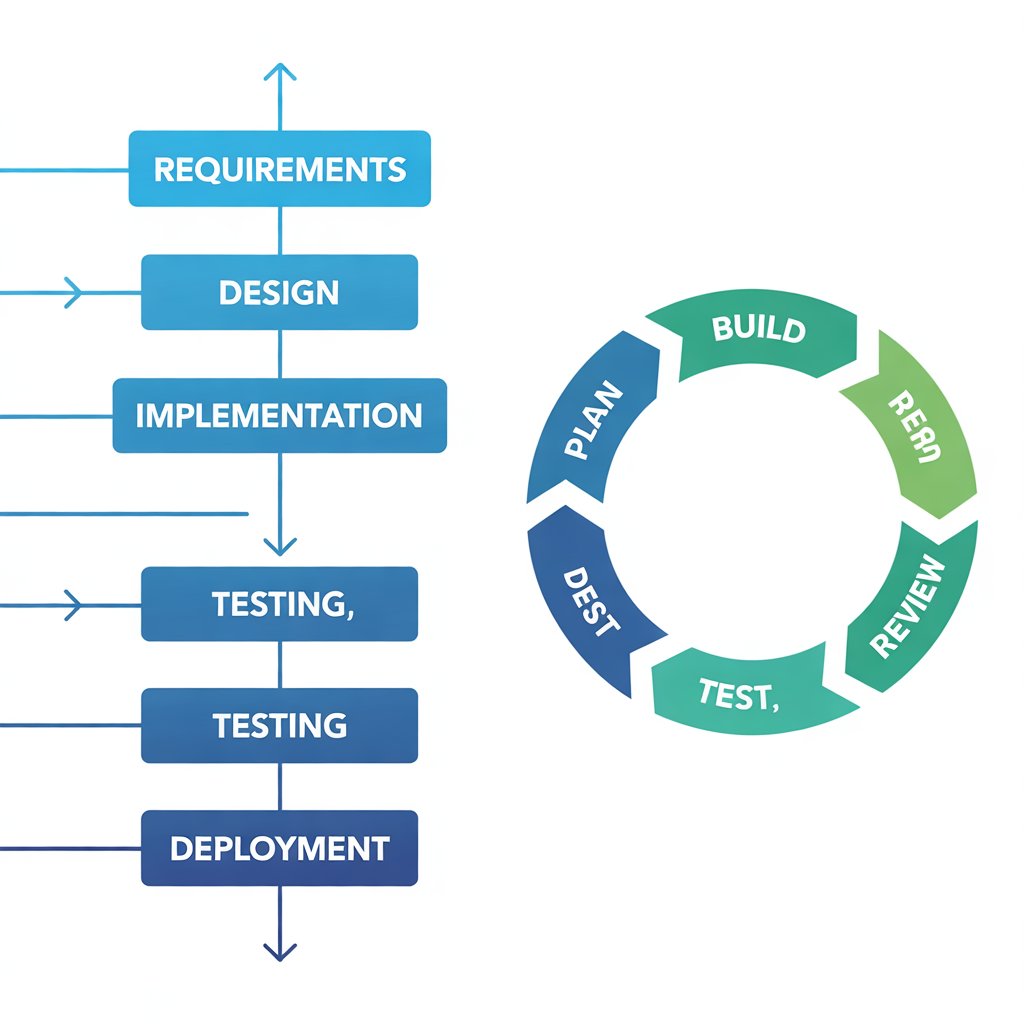
Welcome to one of the most confusing topics for a new project manager. You hear these terms thrown around in every meeting: “Are we using Agile?” “This is a Waterfall project.” “Let’s follow Scrum.”
It’s easy to get lost. Are they all the same? Are they competitors?
Here’s the simple truth: they are just different recipes for getting a project done. Choosing the right one is the key to success. Let’s break down each one with simple examples.
1. Waterfall: The Traditional Recipe
Waterfall is the classic, traditional approach to project management. It’s exactly what it sounds like: a process where you flow downward from one step to the next, just like a waterfall.
You must complete one phase entirely before you can move on to the next.
How it works (The Phases):
- Requirements: Get all the project requirements and sign off on them.
- Design: Create the full design, blueprints, and mockups.
- Implementation: Build the actual product.
- Testing: The QA team tests the entire product.
- Deployment: You launch the finished product.
Simple Analogy: Building a House
You would never build a house without a complete blueprint. You can’t start building the roof before you’ve laid the foundation. The client has to decide on 5 bedrooms before you pour the concrete. The Waterfall model works perfectly for this because the plan is fixed and the final product is clearly defined from the start.
- Best For: Projects where the end goal is 100% clear and unlikely to change. (e.g., building a bridge, manufacturing a car, or a simple website where all content is already known).
- Pros: Very predictable, clear milestones, easy to budget and schedule.
- Cons: Extremely rigid. If you discover a problem or the client changes their mind, it’s very expensive and difficult to go back.
2. Agile: The Modern Mindset
Agile is not a “method” like Waterfall. It’s a philosophy or a mindset.
The core idea of Agile is to be flexible and responsive to change. Instead of delivering one huge product at the very end, Agile is about delivering small pieces of a working product in iterative cycles (called “sprints” or “iterations”).
You build a little, test a little, get feedback, and adapt.
How it works (The Cycle):
- Plan: Decide on a small set of features to build first.
- Build: Create those features in a short cycle (e.g., 2 weeks).
- Test & Get Feedback: Show the working features to the client.
- Adapt: Based on the feedback, adjust the plan for the next cycle.
- Repeat!
Simple Analogy: Painting a Portrait
You don’t just paint a finished eye, then a finished nose, then a finished mouth. You start with a rough sketch. Then you add a base layer of color. You step back, look at it, get feedback. “Maybe the smile should be wider?” You adapt. You add layers of detail, shadows, and highlights, constantly adjusting until the painting is complete. That is an Agile mindset.
- Best For: Complex projects where the end goal is unclear, or you expect requirements to change. (e.g., developing a new mobile app, a complex software, or a marketing campaign).
- Pros: Highly flexible, gets a working product to the client fast, great for customer satisfaction.
- Cons: Can be harder to predict a final deadline or budget, requires a very engaged client.
3. Scrum: A Way to be Agile
This is the most important part to understand: Scrum is NOT a competitor to Agile. Scrum is a framework (a set of rules) for implementing the Agile mindset.
If Agile is the philosophy (like “let’s play a team sport”), Scrum is the specific rulebook (like “let’s play soccer”).
How it works (The “Rules” of Scrum):
Scrum is the most popular way to “do” Agile. It gives you a specific set of roles, events, and artifacts to keep the team on track.
- Roles:
- Product Owner: Decides what to build (manages the to-do list).
- Scrum Master: A facilitator who helps the team follow the rules and removes obstacles. (This is a key PM role!)
- Development Team: The experts who build the product.
- Events (Meetings):
- Sprint: The 2-4 week “box” of time where work gets done.
- Daily Scrum: A 15-minute daily “stand-up” meeting to sync up.
- Sprint Review: Show the client what you built at the end of the sprint.
- Sprint Retrospective: The team discusses how they worked and what to improve.
Simple Analogy: The Restaurant Kitchen
A busy restaurant kitchen runs on Scrum.
- The Product Owner is the Head Chef, deciding the menu (the to-do list).
- The Scrum Master is the Expediter (shouting “Service!”), who makes sure the team has what it needs and that food flows from the kitchen to the customer.
- The Development Team are the line cooks, each an expert in their station.
- The “work” is done in “rushes” (like a Sprint), and they have a quick huddle before service (like a Daily Scrum). They deliver value (food) to the customer in small, fast batches.
- Best For: Any team that has embraced the Agile mindset and needs a structure to stay organized, especially in software development.
The Final Showdown: Which is Right for You?
| Factor | Waterfall | Agile (e.g., Scrum) |
| Project Requirements | Known & fixed from the start | Expected to change & evolve |
| Flexibility to Change | Very low. Change is expensive. | Very high. Change is welcomed. |
| Customer Involvement | Low (only at the beginning and end) | High (constant feedback is required) |
| When to Use | Building a house, a bridge, a simple website | Developing a new app, R&D, marketing |
Your Job as a PM
A beginner PM follows one recipe. A guru PM knows which recipe to use for which meal. Your job isn’t to be a “Waterfall PM” or an “Agile PM”—it’s to be a Project Manager who knows how to select the right tool to deliver clear, successful results.
Need help guiding your project?
Choosing the right methodology can be the difference between failure and success. If you’re not sure which approach fits your complex IT project, let’s talk.
[Contact me] for a consultation, and we’ll build a plan that works.